Why Costco Wins When the Market Wobbles
As a Costco shareholder, I’ve noticed something interesting over the years: Costco often seems to do well when the S&P 500 struggles — and cools off when the broader market is running hot.
It’s not a perfect inverse relationship, but the pattern is strong enough that it makes you wonder what’s really going on. And honestly, in a world full of uncertainty — tariffs, political shifts, and a new Federal Reserve chair — Costco is starting to look like one of the few stocks that actually benefits from volatility. Let’s break down why this happens and why I’m still comfortable holding Costco for the long haul.
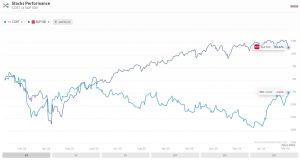
1 Year Chart of Costco VS. SP500
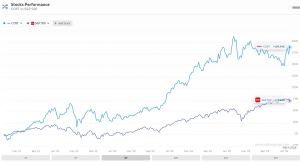
5 Year Chart of Costco VS. SP500
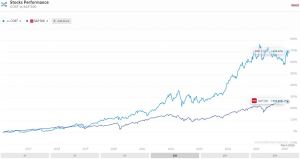
10 Year Chart of Costco VS. SP500
Costco Isn’t a Typical Market Stock — It’s a Stability Stock
Most companies in the S&P 500 rise and fall with economic optimism. Tech stocks soar when investors feel bold and crash when fear hits. Retailers get squeezed by inflation. Industrials get hammered by tariffs. Costco is different.
Costco sells essentials — groceries, household goods, gas, and everyday items. People buy those things whether the economy is booming or wobbling. That makes Costco a defensive stock, the kind investors flock to when the rest of the market feels shaky.
So when the S&P 500 dips, Costco often holds up or even rises. When the S&P 500 rallies, investors rotate back into riskier names, and Costco takes a breather. It’s not magic — it’s the nature of the business.
Membership Revenue Makes Costco Shockingly Predictable
Costco’s real superpower isn’t its bulk goods or legendary rotisserie chicken. It’s the membership model.
Membership fees are:
-
recurring
-
high‑margin
-
stable
-
incredibly sticky
Even when tariffs rise, even when political uncertainty spikes, even when interest rates shift — people keep their Costco memberships. That stability gives Costco a level of predictability that most companies can only dream of.
Why Costco Thrives in Uncertain Times
Let’s be honest: the current environment is messy.
-
A new Federal Reserve chair
-
Tariff threats and trade tensions
-
A political climate that changes direction constantly
-
Market volatility that feels like a roller coaster
In times like these, investors crave companies that don’t depend on perfect conditions to perform. Costco is built for uncertainty.
People don’t stop buying groceries because of tariffs. They don’t cancel memberships because of political drama. They don’t stop filling up their gas tanks because the Fed changed its tone. Costco’s business model is almost boring — and that’s exactly why it works.
Costco as a Long‑Term Hold
Here’s why I’m comfortable holding Costco long‑term, even when the market feels unpredictable:
1. It grows steadily
Costco doesn’t rely on hype cycles. It expands methodically, opens new warehouses, and increases membership revenue year after year.
2. It’s less sensitive to economic shocks
Recessions, rate hikes, political shifts — Costco weathers them better than most companies.
3. It has a fiercely loyal customer base
People don’t casually shop at Costco. They commit to Costco.
4. It’s built for volatility
When the market panics, Costco becomes a safe harbor. When the market rallies, Costco still grows — just more quietly.
My Take as a Costco Shareholder
Do I love watching Costco dip when the S&P 500 is partying? Not really. Do I appreciate how it holds strong when everything else is falling apart? Absolutely.
Costco isn’t the stock that doubles overnight. It’s the stock that compounds quietly, steadily, and reliably — the kind you look back on in 10 years and think, “I’m glad I held onto that.”
In a world full of uncertainty — tariffs, political shifts, and a new Fed chair — Costco is one of the few companies that feels built to survive whatever comes next. And honestly, that’s exactly the kind of stock I want in my portfolio.
 NoMorePoorDad.com
Leave a comment